
This is the 4th blog that I’ve started. The first one was back in 2009 on Blogspot named ‘Broken Human Telephones’. It no longer exists. The second one was again hosted on Blogspot and ran between 2009 and 2014 (yes, the first one was very short-lived). ‘Minus White’, my second blog, is still alive, albeit the fact Photobucket stopped hosting my pictures so most of them have a large Photobucket watermark on them. And, the third one was hosted with a purchased domain name that never actually saw the light of day – not even a single post. I stopped the domain service eventually and the website was taken down. So, technically, this is my 4th blog. The 3rd one was empty though.
Anyway, the goal of having a website for me is quite simple. I want a writing space that I can air out some thoughts, work out a riddle, or just explore ideas. I want it to be public to keep myself more grounded and better stress-test my journey of thought. I’ve aptly named this site ‘Minus White’ again. I’ll explain why. If you consider a jigsaw puzzle, for example, you have one (or more) puzzle pieces of interest at a given time. What’s missing are the pieces in the space between – the linking piece(s). I think of this space being white. And, in the process of trying to connect the pieces, what I envision doing is filling them. Hence, ‘Minus White’.
There’s a bit more to it though.
The title ‘Minus White’ is a reference to the concept of negative space. In architecture, negative spaces are created by hollowing out a solid that already exists. A window is a negative space. A vaulted ceiling is a negative space. A fireplace is a negative space. A room is a negative space. You get the point. What’s not obvious is negative spaces, by definition, are accompanied by positive spaces. After all, a space only exists within the confounds of its frame, that frame being a positive space. The window frame, ceiling or a roof, bricks that surround the firepit, and the walls that enclose your room are all positive spaces.
Take a look at this Islamic mosque vaulted ceiling, called muqarnas. Isn’t it absolutely gorgeous?
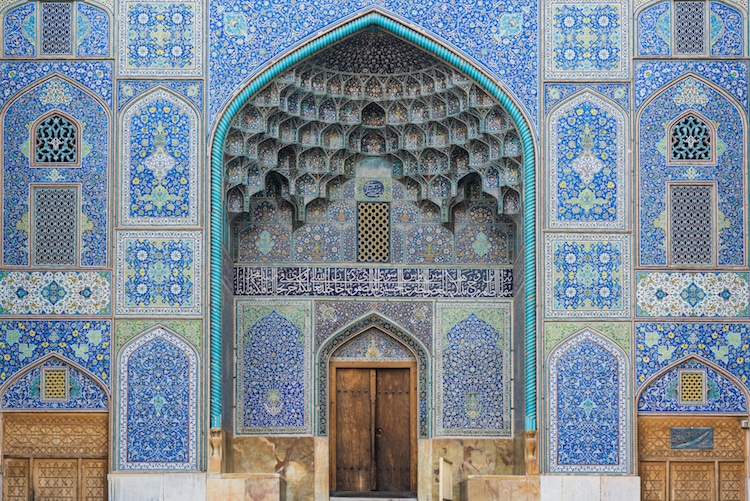
Now, how does this relate to ‘Minus White’ and my modest ambition to create another verbose monologues on the Internet (a.k.a. blog)? It’s my conceptual attempt to be mindful of negative spaces. Positive spaces are often more explicit and tangible. They are much ‘louder’, and they easily draw our attention. However, a positive space in architectural motif lends itself to its complementary negative space. It has to. And, to fully experience architecture like the mosque above, you need to understand both.
When experiencing architecture, which is any time you’re near a building, we first see positive spaces in the form of its walls, columns, window shapes and sizes, doors, stairs, and so on. We only experience negative spaces by occupying the space. Negative space is not something you visualize without a conscious effort. Rather, you feel it. After all, what use would thinking about the negative space created by a staircase help you get to the lower floor? You’re busy looking at the actual staircase so your foot doesn’t miss a step. On the other hand, if you were simply passing by a staircase, you wouldn’t know how frustrating it would be to climb down that staircase because the damned architect was adamant about a spiral staircase in such a small space, lending to unwalkable, steep, and narrow step towards the center. The staircase looks beautiful from afar, however. Definitely Instagram-worthy.
You can look through photographs of mosques and remark at the details of their vaulted ceilings. But, you won’t be able to experience them until you’re in their presence. And, of course, a mosque is a complex building with many geometrical shapes, patterns, edges, sides, walls, columns, windows, ornaments, and so on. Negative space connects each individual elements to ‘tell’ a comprehensive outlook. Hence, careful study of each space types and their relationships are crucial for holistic understanding of an architectural piece. I think same is true for writing, painting, music, film, and just about any form of art.
Continue to pt. 2/3.
 Minus White
2 thoughts on “Minus White (pt. 1/3)”