
Read pt. 1/3 here.
In a visual medium, such as Renaissance fine art, the artist depicts positive and negative spaces by painting a scene where the main subject (often at the center) is surrounded by other people and objects. To be precise, paintings prior to modern era were largely agnostic to the concept of negative space. The best depiction of negative spaces were landscape paintings, but even then, many would have illustrations of people afar. Negative space wasn’t something that was formalized until the early 20th century when the Suprematist movement began during the World War 1.
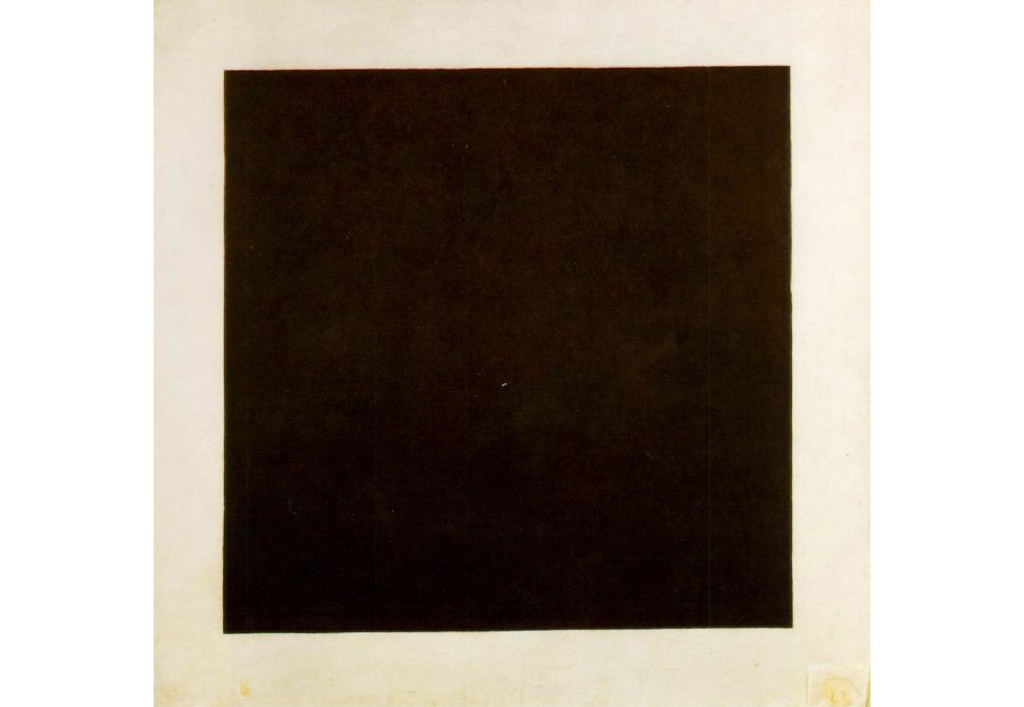
I agree with many criticisms, especially from the public, that abstract art looks too haphazard, elementary, and/or sometimes feels too ‘cheap’, not unlike the wallpaper design you choose to plaster on your bathroom. Take the above painting by Kazimir Malevich. It could definitely be made into marble patterns to cover your floors. It’d be too ‘retro’ for my taste, but I’m sure it’d fit someone’s design wishes.
I empathetically agree because without context, abstract art is much more difficult to understand than its previous movements. And, while I love the modern and contemporary movements overall, I understand I’m in the minority that actively searches for the stories behind them. It’s not practical. But that doesn’t mean they (or some of them, at least) don’t deserve a place in our history. It can be just as rich as some of the classically acclaimed Baroque and Renaissance paintings.
Take the ‘Black Square (1915)’ by Kaimir Malevich (above) and his comments:
It is from zero, in zero, that the true movement of being begins.
I transformed myself in the zero of form and emerged from nothing to creation, that is, to Suprematism, to the new realism in painting – to non-objective creation.
[Black Square is meant to evoke] the experience of pure non-objectivity in the white emptiness of a liberated nothing.
Kazimir Malevich
To Kazimir Malevich, then-popular Impressionism and Cubism movements weren’t enough. Impressionism took a step in rejecting traditional objective reality and introduced us a dimension of subjective experiences by tempering color, texture, and perspective. While maintaining the same photographic composition as its predecessors, it transformed the same scenery of people and landscapes into impressions, or subjective reality. Cubism, basically, took it one step further and said, “That’s great, but why limit paintings to a single perspective?” They broke the reality down into elementary shapes and color, thereby reducing a point of reference. Hence, a Cubist painting often has no depth of field, the subjects are largely distorted, and its colors are exaggerated. But, for Suprematists, it could go even further. They replied, “True subjective experience is the manifestation of your thoughts and feelings, unadulterated by worldly perceptual inputs. Subjective experiences should ultimately be devoid of objects.”
Focusing on the negative space.
That’s essentially the philosophy of Suprematism and few other movements that built on top of it, such as De Stijl (e.g. Piet Mondrian), Abstract Expressionism (e.g. Jackson Pollock), and Minimalism (e.g. Cy Twombly).
Kazimir Malevich wanted to reveal and make known what lies beyond our perceptual experiences. The focus on negative space isn’t to rid of all objects, but be mindful of the other ‘half’. And, I think it’s a great message. It’s important to be mindful of negative space because when you rid of all ‘objects’ (or any perceptual experiences, although practically impossible), that’s where the true subjective experience lies. However, it’s equally important to consider that they’re complementary and one can’t exist if the other ceases.
This brings me to the classical “Is the cup half-full or half-empty?” question.
Continue to pt. 3/3.
 Minus White
2 thoughts on “Minus White (pt. 2/3)”